CPCSC/CMMC Readiness with Microsoft 365: What Canadian Suppliers Should Configure
Microsoft 365 can support CPCSC and CMMC readiness, but it does not remove your responsibility for scope, configuration, evidence, and attestation.
Quick Answer
Can Microsoft 365 support CPCSC or CMMC readiness?
Yes, Microsoft 365 can support identity, device, sharing, retention, audit, and information-protection controls. It does not certify your organisation. Canadian suppliers still need to define SI scope, document which Microsoft controls are inherited, configure tenant settings, keep evidence, and record CPCSC proof in CanadaBuys when required.
Who this applies to
Canadian defence suppliers deciding whether Microsoft 365 scope, tenant controls, evidence, and cloud boundary choices are enough for CPCSC or CMMC readiness
Timeline
Review tenant scope before summer 2026 CPCSC Level 1 contract awards or U.S. CMMC flow-downs
Investment
Budget for configuration, evidence, and user change, not only licenses
Guide
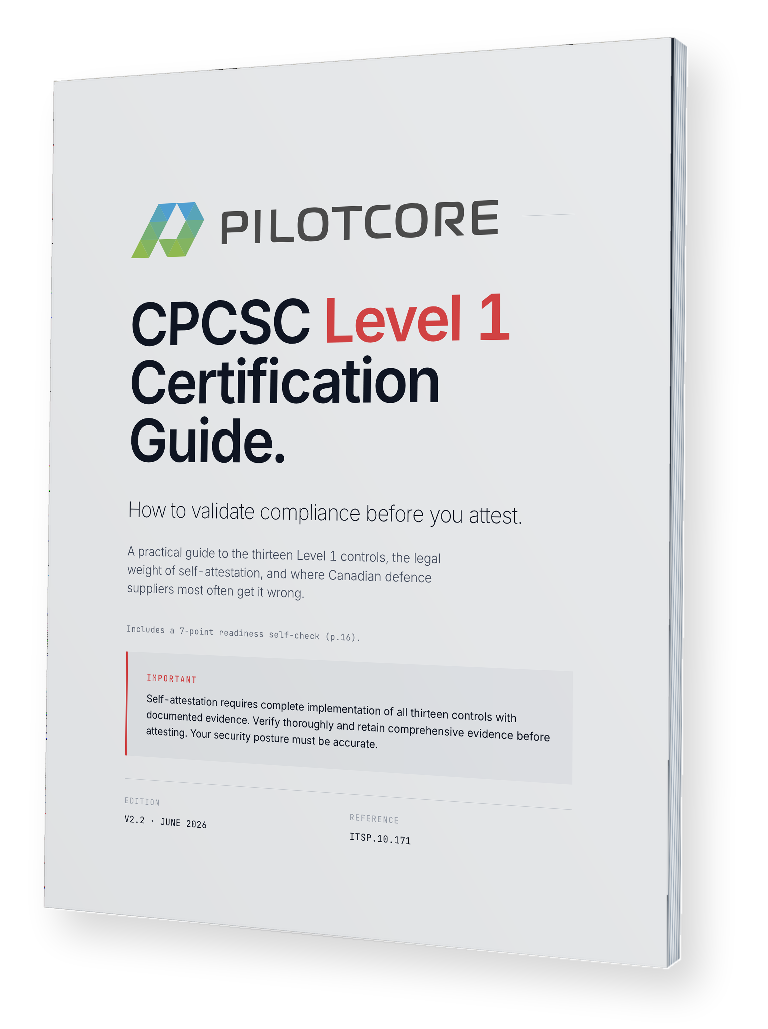
Get the CPCSC Level 1 planning guide.
Use the guide to connect Microsoft 365 settings to CPCSC scope, evidence, and the 13 Level 1 controls before you change licenses or tenant boundaries.
Check your inbox.
We sent the guide link to the email you entered.
Setup
What to configure first.
Identity
MFA, a Conditional Access baseline, named accounts, privileged access review, break-glass accounts, and joiner-mover-leaver records.
Sharing
External sharing limits, guest access reviews, approved collaboration locations, and public-link blocking.
Devices
Intune or equivalent device compliance, encryption, endpoint protection, and patch reporting.
Information protection
A label taxonomy, sensitivity labels, DLP rules, retention policies, and records showing where SI, FCI, or CUI is stored.
Audit and evidence
Audit retention, screenshots, exports, access reviews, policy settings, administrator logs, and cloud-provider documentation.
Sequencing
Do not start with the license debate.
For Canadian CPCSC work, start with the contract, information type, residency needs, controlled goods exposure, supplier role, and systems in scope. For U.S. CMMC work, start with FCI or CUI handling and the contract level. License and cloud-boundary decisions follow those facts.
A tenant can have good controls and still fail readiness if SI or CUI leaks into personal email, unmanaged endpoints, third-party file shares, or subcontractor systems with no evidence trail.
Cross-border
When GCC High enters the conversation.
GCC High is built for U.S. government and defence requirements, including suppliers handling CUI, ITAR, or other U.S. export-controlled data. Treat it as a U.S. DoD, CMMC, CUI, ITAR, or export-control requirement question. It can be the right answer for a Canadian supplier with U.S. CMMC or DFARS-driven obligations, but it is not an automatic CPCSC requirement.
For Canadian work, check the contract first. If Controlled Goods data is involved, the Controlled Goods Program says registrants should review data residency options that keep controlled goods data on servers located in Canada, and consult Global Affairs Canada for data stored outside Canada. Canadian cloud categorization guidance also treats information sensitivity and deployment context as design inputs. CPCSC scope is a separate question: which people, devices, Microsoft 365 workloads, subcontractors, and records handle specified information for the contract. A cross-border supplier may need one Microsoft 365 design for U.S. CUI and another boundary for Canadian data residency expectations.
Microsoft documentation can help show which controls are Microsoft-operated, customer-operated, or shared. That inheritance still has to be mapped to your tenant settings, users, devices, data locations, and evidence. Microsoft 365 government cloud alignment does not transfer CMMC or CPCSC certification to the customer.
Pilotcore
Need a Microsoft 365 readiness map?
Pilotcore maps Microsoft 365 tenant settings to CPCSC and CMMC readiness goals, including scope, shared responsibility, evidence, and remediation. We provide readiness support, not official certification.
References
Official sources.
- Microsoft and CMMC
- Microsoft Office 365 GCC High and DoD
- Microsoft shared responsibility in the cloud
- Canada Controlled Goods cloud guidance
- Canadian Centre for Cyber Security cloud categorization guidance
- Government of Canada Level 1 requirements
- Government of Canada Level 1 scoping guide
- DoD CIO CMMC overview